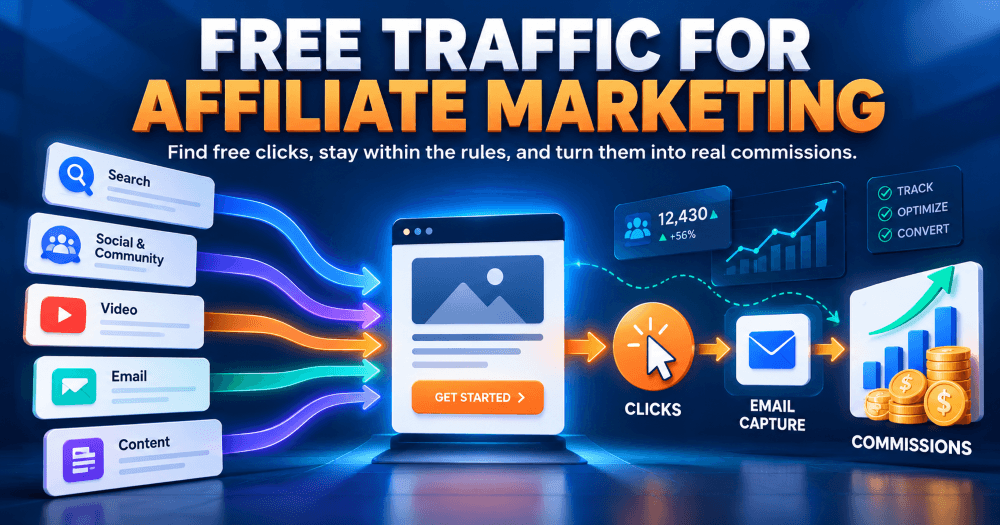
How to get free traffic for affiliate marketing and make it pay: finding sources, staying within platform rules, bridge pages, email follow-up and tracking.
Here’s a sum that catches out a lot of affiliates.
You promote an offer paying $50 a sale. It costs you $40 in ads to get each buyer. You’ve made $10, and that’s on a good day, before the campaigns that don’t work.
Paid traffic has its place, but the ad platform always takes its cut first. Free traffic flips that: nobody charges you for the click, so more of every commission stays with you.
The catch is that free traffic isn’t effortless, and it isn’t automatically profitable. This guide covers free traffic for affiliate marketing properly: where to find it, how to stay within each platform’s rules, and the three things that turn free clicks into actual commissions.
What “Free Traffic” Really Means
Free traffic means visitors you don’t pay for per click: people who find your content through search, communities, social platforms, video, email or other people’s audiences.
It’s free in money. It costs time, and it needs care. The upside is that good free traffic tends to compound: a useful post, pin, answer or video can keep sending visitors for months.
Where Free Traffic Comes From
- Search: blog posts and pages that answer what people type into Google.
- Pinterest: a visual search engine where people plan and buy.
- YouTube: how-to and review videos with links in the description.
- Communities: Reddit, Facebook groups, forums and Quora, where people ask for help.
- Publishing platforms: Medium, LinkedIn articles and newsletters.
- Other people’s audiences: guest posts, podcasts, swaps and partnerships.
- Your own email list: the most valuable traffic source of all, once you’ve built it.
The best sources for you depend on the offer. A KDP book, a software tool and a fitness product have buyers in very different places. Finding the overlooked places where your particular buyers already gather is the research most people skip.
Step 1: Stay On the Right Side of the Rules
Free traffic comes from other people’s platforms. You’re a guest, and every platform has rules about promotion. Break them and you lose the account, and the traffic with it.
- Value first. Every post should be useful even if nobody clicks.
- Read each community’s rules. Many subreddits and Facebook groups ban affiliate links or allow promotion only in certain threads.
- Disclose. Advertising rules in the US and UK require clear disclosure of affiliate links, such as #ad or a plain sentence.
- Warm up new accounts. Take part for a couple of weeks before you post links.
- Go slowly. A few good posts beat a burst of identical ones.
- Use clean links. Generic public shorteners are common in spam; links on your own domain look more trustworthy.
Step 2: Send Clicks to a Bridge Page, Not Straight to the Offer
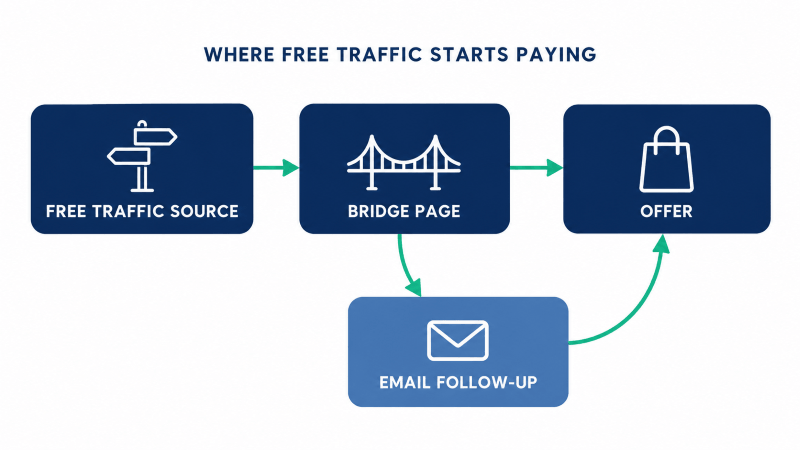
Send a cold visitor from a forum straight to a long sales page and most of them leave for good. A bridge page sits in between.

A good bridge page is short and does three jobs: it warms the visitor up with a headline that matches where they came from, it adds your honest angle on the offer, and it offers something free in exchange for an email. Many platforms are also happier with a link to a genuinely useful page than a raw affiliate link.
Keep it to a headline, a short hook, three honest bullets, one button, an optional opt-in and a clear disclosure. Check it on your phone, because most free traffic arrives on one.
Step 3: Follow Up By Email
Most people who click don’t buy that day. If your bridge page captured their email, you get more chances.
A simple seven-day sequence works well:
- Day 0: deliver the freebie
- Day 1: one quick, useful win
- Day 2: a short, true story about the problem
- Day 3: the recommendation, with honest limits
- Day 4: answer the biggest objection
- Day 5: proof or a demo
- Day 6: a reminder (with a real deadline only if there is one)
- Day 7: what happens next, and an invitation to reply
Check each affiliate programme’s terms before putting its links in email. Some, including Amazon’s, restrict it. Where that applies, link to your own page instead.
Step 4: Track What’s Working
Once you’re posting in several places, you need to know which ones pay. The most important habit is simple: one link per placement. A separate link for each post, pin, video and email.
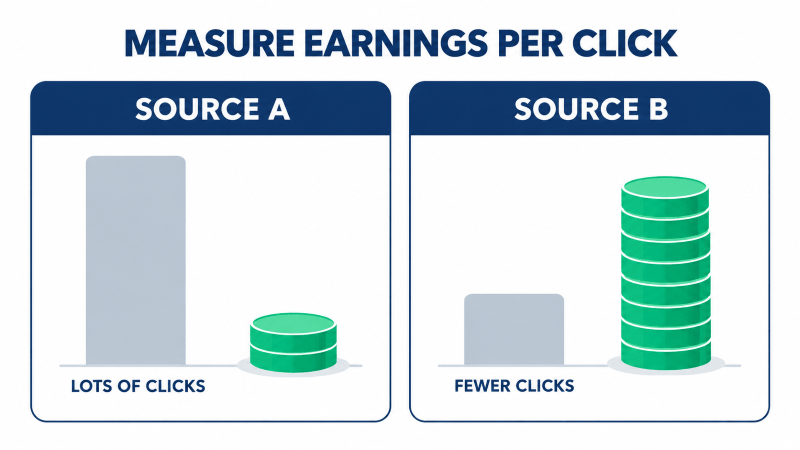
Then track four numbers per source: clicks, opt-ins, sales and earnings per click.

Earnings per click matters most. A source sending 50 clicks that each earn £1 beats one sending 500 clicks that each earn 5p. Spend fifteen minutes a week reviewing the numbers, and decide one thing to do more of, one to stop and one to test.
Tracking also catches dead links. Offers retire and programmes change their links, and old content keeps getting clicks long afterwards. I’ve written about how to find and fix those in my post on broken affiliate links.
A Simple Weekly Free Traffic Routine
Consistency matters more than intensity with free traffic. Here’s a routine that fits around a busy week:
| Day | Task | Time |
|---|---|---|
| Monday | Review last week’s numbers and pick this week’s focus | 15 minutes |
| Tuesday | Create one useful piece of content for your best source | 45 minutes |
| Wednesday | Take part in two communities: answer, comment, help | 20 minutes |
| Thursday | Repurpose Tuesday’s content for a second platform | 30 minutes |
| Friday | Email your list with one tip and one recommendation | 20 minutes |
That’s a little over two hours a week, and every hour of it compounds.
Common Free Traffic Mistakes
- Spreading too thin. Ten platforms done badly beat by two done well. Start with two.
- Linking too early. New accounts that post links straight away are the ones that get removed.
- Sending traffic straight to the offer. Without a bridge page and an opt-in, every visitor who isn’t ready is lost.
- Judging too soon. Free traffic builds slowly. Give a source a few weeks before you decide.
- Not tracking. If every placement shares one link, you’ll never know which one worked.
- Hype. Income claims and exaggerations get posts removed and readers suspicious.
The Research Problem
If you’ve read this far, the hardest part is probably clear: working out where the buyers for this particular offer actually are. The obvious platforms are crowded. The overlooked ones take digging.
Traffic Blackbox AI: What It Does
Traffic Blackbox, from UK affiliate Ben Fletcher, is a cloud-based AI tool built to do that research for you.
- tell it what you’re promoting: an affiliate offer, your own product, a service, a webinar or a KDP book
- it researches and identifies traffic sources it considers under-used for that offer
- it builds a full traffic campaign, with your link inserted automatically
- it gives you a step-by-step plan to follow
- it runs in an online members area: nothing to install, no hosting, no AI account or API key
It also comes with three launch bonuses: a Free Traffic Hacks Masterclass, an Untapped Free Traffic Sources training and an Affiliate Opportunity Crusher AI tool for finding high-ticket and recurring programmes. It’s $17 at launch, normally $97, with a 30-day money-back guarantee.
My Verdict
Ben’s own page says it isn’t for anyone expecting a magic button, and that’s the right way to see it. You still have to create the content, post it, follow each platform’s rules and look after the clicks once they arrive.
What it does well is the step most people never get round to: per-offer research into where the buyers actually are, turned into a campaign and a plan. Pair that with a bridge page, an email follow-up and simple tracking, and you’ve got the whole free traffic system rather than half of it.
My Bonuses If You Pick It Up
If you buy Traffic Blackbox through my link, I’ll send you four reports covering what happens after the click:
- The Bridge Page Kit: six building blocks, three templates and an AI prompt to build the page
- The 7-Day Follow-Up Sequence: seven fill-in-the-blank emails
- Free Traffic Without the Ban Hammer: platform-by-platform rules and a pre-post checklist
- Know What’s Working: simple tracking and a 15-minute weekly review
See Traffic Blackbox and my four bonuses here →
Frequently Asked Questions
Can you do affiliate marketing with free traffic?
Yes. Many affiliates rely on search, Pinterest, YouTube, communities and email rather than paid ads. It takes more time than paid traffic, but you keep more of each commission.
What’s the best free traffic source for affiliates?
It depends on the offer and where its buyers spend time. Over the long term, your own email list is the most valuable, which is why capturing emails from free traffic matters so much.
Do I need a website for free traffic?
Not strictly, but a simple bridge page between your traffic and the offer usually converts better and lets you build an email list.
Can I post affiliate links on Reddit?
Sometimes. Many subreddits ban them, and Reddit’s rules prohibit spam. Read each community’s rules, contribute genuinely, and disclose any affiliate links you share.
Disclosure: this post contains affiliate links. If you buy through one of them I earn a commission at no extra cost to you.